Showing posts with label Star Wars. Show all posts

Postmodern Theories: The Collapse of Metannarratives


A metanarrative put simply is a big story off which people base their beliefs, the most well known metanarrative is the bible and religion. Other examples of metanarratives include science, art and modernism, they are narratives which make universal and all-embracing claims of knowledge and truth. It is believed that in the postmodern world metanarratives are beginning to decline and are less important to people's lives. Postmodernism is very skeptical of the metanarratives and believes that they are open to criticism, the validity of the metanarratives is beginning to decline. 

Whats next?...
Lyotard proposed that the metanarratives should give way to smaller localised narratives. Postmodernists attempt to replace the metanarratives by focusing on local contexts and the diversity of different peoples experiences. They believe that there are a series of smaller narratives rather than just one all-encompassing narrative. 

I think that Lyotard's theory can be seen in many different media as I believe that the metanarratives are no longer used as much in media. Metanarratives are becoming a smaller part of many peoples lives, for example churches in England have been in decline since the 1950s with an estimated 1 million giving up church going in the 1990s alone. Only 7.5% of the UK's population attended church  regularly in 1998. I think that the media is coming to reflect this change which is leading to a decline of metanarratives. 

With the decline of metanarratives I believe that we are seeing the creation of smaller narratives which better represent smaller minorities. An example of this is the Jedi census phenomenon. On 2001 many residents recorded their religion as "Jedi" or "Jedi Knight" on the national census. In England and Wales the national census revealed the religious affiliations as being: 70% Christian, 14.7% no religion, 3.1% 7.8% chose no response, Muslim, 2.1% Hindu and 0.7% Jedi. In 2011 176,632 people responded as Jedi. This suggests that people are choosing to identify with stories/narratives that better appeal to them and that are more relevant. 
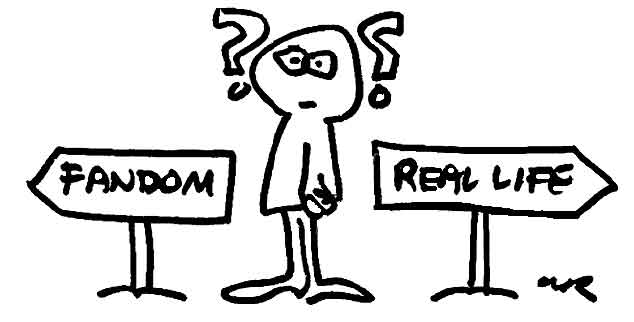
I thin that this can also be seen in pop culture among teenagers and the rise in popularity of 'fandoms'.  A 'fandom' is a term used to refer to a subculture composed of fans characterised by a feeling of empathy and camaraderie with others who share a common interest. It is suggested that the first fandom was compromised of fans of Sherlock Holmes. Public demonstrations of mourning after Holmes was "killed off" in 1893 were held and some of the first fan fiction was created as early as 1897-1902.  

Useful links: 
http://news.bbc.co.uk/1/hi/uk/5349132.stm
http://www.vexen.co.uk/UK/religion.html

Postmodern Theories: Hyperreality


Definition: 'a condition in which "reality" has been replaced by simulacra'

What is Hyperreality? 
In semiotics and postmodernism, hyperreality is an inability of consciousness to distinguish reality from a simulation of reality, especially in technologically advanced postmodern societies. It is seen as  a condition in which what is real and what is fiction is blended together so that people can no longer tell which is "reality" and which is not. 
The term was coined by Jean Baudrillard, he defined it as "the generation by models of a real without origin or reality". He suggested that the world in which we live has been replaces by a copy world, where we seek simulated stimuli and nothing more. 

Application in the real world
Hyperreality can be seen throughout media in our world. The above image is a realistic image that has been digitally created by merging of two images. One of the images used is of a real place, the other image has been created digitally and merged with the real image. The image illustrates how the advancements in technology have allowed the boundary between what is real and what is not to become blurred. Some people would look at the image and think that it was real, its not unless you recognise the iconography in the image from Star Wars or unless you look closer that you realise that it is not a real image. 
Hyperreality can also be seen in TV news and the different place from which people get their information. Some newspapers report that global warming is a real process which is happening and is going to damage out world, other newspapers report that global warming is fake and that we shouldn't worry about it. Depending on which article you read you get two different views and pieces of information, so how do you know which is right and which is wrong? The answer is you don't, this is hyperreality, you are being given two different sets of information one which is fiction and one which is reality but they become blurred so you can no longer tell which is real and which is not. On TV news it can be seen when they televise news and wars as though they are reality TV. Wars are now reported in a similar fashion to reality TV. After the reports of terrible news have been shown they move on to a lighter segment such as entertainment news or an advert which shows a product being advertised happily. This can be seen as creating a hyperreality as the boundaries are being blurred. One moment you are being told that the world is a terrible place and the next you have a happy ad or news segment which is telling you the world is fine and everything is ok. How then can we tell the state of our world. People like TV to be this way because they like to know that they are ok and that their world/'reality' is safe, even when in another country others are suffering. 

https://www.youtube.com/watch?v=5RwhEHzuulA&feature=youtu.be

Star Wars: The Force Awakens Poster


Print based media, as well as moving image media, can be considered postmodern. Here I have looked how the poster for Star Wars: The Force Awakens could be considered postmodern. There are actually many aspects of the poster which could be considered postmodern, from the hyperreal elements of the poster to the aesthetic of the poster. On first glance you notice the main postmodern elements of the poster such as the layout of the poster and its similarity to the original posters, but on further inspection you can begin to see other postmodern elements in the poster such as how it disregards the metanarratives.